Novels as Mentors
I was about halfway through Columbia’s Master’s Writing Program in Fiction when it hit me: I still didn’t know how to begin a novel, let alone finish one. Like many aspiring novelists, I had been working on short stories. I had figured someone would show me how to make the leap from writing 5,000 word stories (20 pages) to writing 75,000 word novels (300 pages).
But there I was, about to start work on my thesis, and I still had no idea how to make a story stretch to 20 times the length of the stories I’d been writing. I knew I couldn’t just add more words, because all that would give me would be the never-ending story.
I also knew that I wanted to write a novel while I was in the writing program, because that was why I was spending the big bucks – to learn to write a novel. So what to do?
I picked a mentor novel. It was Puffball, a slim novel by Fay Weldon. I picked the book because a) I liked it and b) there was something about the tone and pacing and style of the book that felt like the stuff I was writing. I felt that this book fit my sensibility, even though the plot and characters weren’t exactly what I would write, and neither were the characters.
And then I used the structure and pacing of Puffball to guide me through the structure and pacing of my novel.
For example, here were the kinds of questions I asked Puffball:
How far into the book are all the major characters introduced?
How many points of view are there?
When does the protagonist’s (main character) main problem get set up?
When does the antagonist’s (character working against protagonist) problem get set up?
When do minor character’s problems get set up?
How quickly does the protagonist’s problem grow into something bigger?
When does the problem become absolutely overwhelming?
What does the protagonist do at this point?
How does the antagonist react?
What is the new status quo as the book ends?
I didn’t use words like “dark moment” and “crisis/climax” and “second act turn” because back then I didn’t know them. Columbia’s MFA program focused on whether fictional events seemed “authentic” or “manipulated” and analyzed whether scenes “worked”. As far as I can recall, there was no formal discussion of three act structure, or instruction about how to set up subplots, or how to resolve them, or when to resolve them.
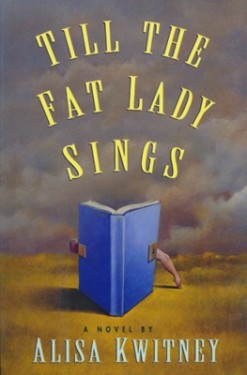
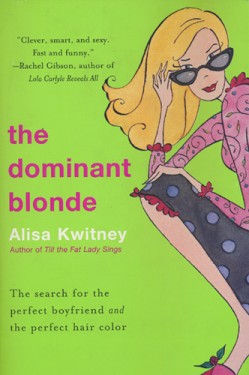
Puffball, and by extension Fay Weldon, taught me all that. At least, for that novel (Till the Fat Lady Sings, which was later published by HarperCollins). Other books required other mentors. For The Dominant Blonde, which was a crime caper as well as a romance, I used two mentor novels, one a crime caper and the other a contemporary romance. (I can’t recall which ones, but the authors were Carl Hiaasen and Rachel Gibson). I also was inspired by the Fawlty Towers episode, “The Kipper and the Corpse.”
If this is your first novel, however, I suggest picking one mentor novel. It should be a novel you really love, in a style and sensibility that feels native to you. Your novel shouldn’t have the same characters or plot, but should probably be in the same section of the bookstore: YA Fantasy, for example, or romantic thriller, or contemporary women’s fiction.
Then go ahead and use the mentor to show you structure and pacing. In addition to the questions I raised above, you could ask:
How much physical description of characters?
How much scene setting?
How is dialogue broken up by physical actions?
How much is explained about character’s emotions, and how much left for the reader to infer?
What kinds of slang or jargon are used to reveal characters’ backgrounds and make their voices distinct?
Important Note: Of course, the mentor novel is only a rough guide, and your novel doesn’t have to do precisely what the mentor novel does on the exact same page.
Are you picking a mentor novel? Which one?